
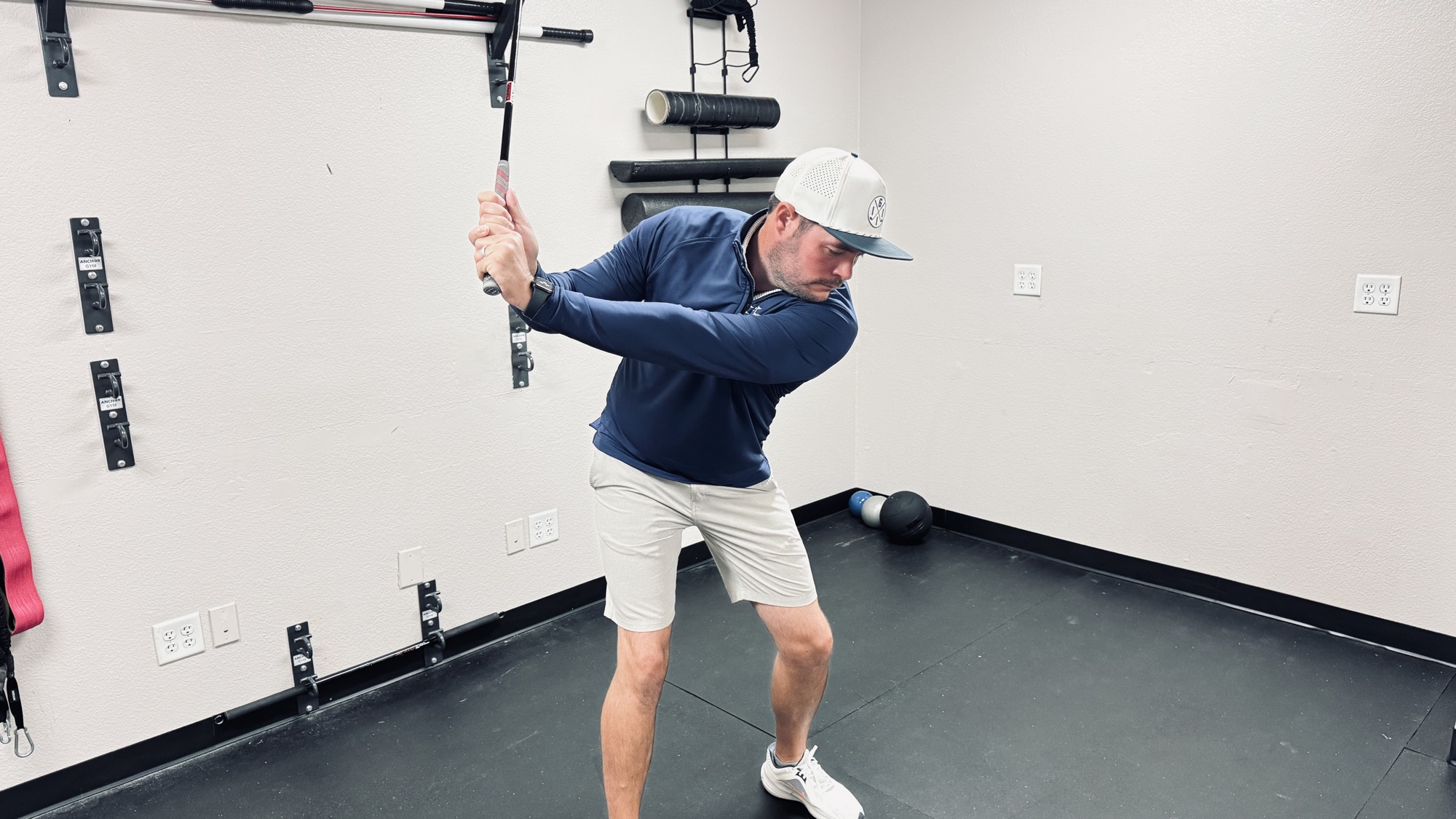
You get to the top of your backswing loaded up, you feel like you unload everything you've got — and the ball just sits there. Meanwhile the guy you play with looks like he's swinging at 70% and it rockets off the face. If that's you, the problem probably isn't effort. It's timing — specifically, when your body actually starts producing force.
The idea that reframes the whole thing comes straight out of the force-plate research at the Titleist Performance Institute (TPI). Dr. Greg Rose and Dave Phillips have a great breakdown of it — worth a watch here. What follows adds the piece their video doesn't cover: what your body has to be able to do to pull it off, and how we check it here in Fort Worth.
The mistake: thinking the downswing starts at the top
Most amateurs picture the swing like a two-step move: turn all the way back, arrive at the top, then fire down. Stop, then go.
Elite players don't do that. Put them on a force plate — a device that measures how hard and in what direction they push into the ground — and something surprising shows up. They're already driving force into the ground while the club is still going back. The trail foot starts pushing before the club ever reaches the top. By the time the pelvis visibly changes direction, the forces that reverse it have been building for a while.
There's a name for this from basic physics: force precedes motion. You can't move without something pushing first. When you walk, you push into the ground and the ground pushes back — that's what actually moves you. In the golf swing, that "ground reaction force" is what spins your hips. The great players set it up early. The amateurs wait until the top and then scramble to create it.
Which way your feet actually push
The mechanic is simpler than it sounds. To spin your hips toward the target, elite players use the ground like two hands shoving opposite corners of a box: the trail foot presses down and back through the heel, and the lead foot presses forward through the ball of the foot. Push down-and-back on the trail side and the ground shoves that hip forward; push forward on the lead side and the ground pushes that hip back. Those two opposing shoves are a "force couple" — and that's what turns your pelvis.
You've actually seen this fail in real life. It's why a player slips: the trail foot kicks back or the lead foot slides forward out from under them. That's the exact same push, just without the traction to turn it into rotation. On solid ground, that grip is what spins you instead.
Want to feel it? Put a small slant board — or even a rolled-up towel — under your trail heel and press down into it. That little wedge exaggerates the down-and-back push so the direction clicks.
The part most golfers get backwards
Here's where it gets useful, and where I'll push back on advice you've probably heard.
The common cue is "coil harder — turn your shoulders against your hips and store up power at the top." The problem is that building and holding a big stretch at the top is one of the least efficient ways to make power. When you coil and pause, the stored energy leaks away before you ever use it — like stretching a rubber band and then just holding it there for a second before you let go. Not much snap left.
What the long hitters actually do is different: they let the pelvis start turning back toward the target first, while the upper body is still finishing the backswing. That brief moment where the bottom half is going one way and the top half is still going the other creates a fast, dynamic stretch across the trunk — and that's the rubber band, loaded and released in the same instant. No pause, no leak. Power isn't stored by coiling and holding. It's created by the lower body reversing first.
To do that, your body needs one specific ability: separation — the capacity to move your pelvis independently of your rib cage. If your hips and shoulders can only move as one block, you physically cannot lead with the lower body. You're stuck making an all-arms swing from the top — which is exactly the "fast but no distance" feeling. Underneath a separation problem is often a stiff mid-back (your thoracic spine — how well your upper back rotates) or a restricted trail hip that can't load and turn.
Test yourself: the one-block check
Stand in your golf posture — club held across the front of your shoulders, chest tilted over the ball like address. Feet planted.
- Hips test: Keep your chest and the club as still as you can, and try to rotate just your belt buckle to the right, then the left. Can you turn your pelvis while your upper body stays quiet?
- Chest test: Now lock your hips and try to rotate just your chest and shoulders over a still lower body.
If you can move each one on its own — good, you've got separation to work with. If your shoulders drag your hips along, or your hips drag your chest — everything moving as one block — that's your power leak. You can't sequence what you can't separate.
(This is a simplified version of two screens we run in the clinic, the pelvic rotation and torso rotation tests. The pelvic one is the headliner for this topic, because pelvis-leads is the whole move.)
How we'd fix it
Hands-on work comes first, and it works fast — if your mid-back or trail hip is genuinely restricted, freeing that up with adjustments and soft-tissue work can restore range in a single visit. But that's the start, not the finish. The lasting change comes from re-teaching your body to separate and then to sequence. The drills below are what turn a one-time range gain into a swing that repeats it. Get things moving, then own the new range.
Why the power leaks: your core is the transmission
Here's the piece that ties it together, and it's the one most golfers miss. When you press down and back through that trail heel, you've basically started a leg press against the ground — and that force has to go somewhere. If there's a stiff link between your pelvis and your rib cage (a braced core), the force gets channeled into rotation: it turns your pelvis and loads your midsection like a spring.
But if that core is loose, the same push takes the cheap exit. Your trail leg just straightens and drives you up and back — so instead of turning, you feel yourself shoved into more backswing, standing taller, maybe swaying off the ball. Same energy, leaking into extension instead of rotation, usually with a little arch in the low back for good measure. (This is the exact thing I feel the moment I stop bracing — the ground just pushes me deeper into the backswing.)
So your core isn't a "support muscle" here — it's the transmission, the thing that converts a push from your legs into a turn of your hips. The cue is simple: brace first, then push. Braced, the ground turns you. Unbraced, it just stands you up.
Four drills to build it, in order
Do these in sequence. The first restores the separation, the second trains fast force from the ground, the third grooves it into a swing, and the fourth builds the core stiffness that makes all of it transfer.
1. Separation, two ways (dissociation drills)
- Standing pelvic turns: In golf posture, club across your shoulders, keep your chest pointed at the ball and rotate only your pelvis side to side. Slow. Exhale as you turn to find a little more range. 8–10 each side.
- Tall-kneeling chest turns: Kneel upright, squeeze your glutes and tuck your pelvis so your lower body is locked, then rotate your chest and shoulders as far as they'll go each way. The locked base is what forces the mid-back to do the turning. 8–10 each side.
2. Rotational medicine-ball throw (the power move)
This is the one that trains force-precedes-motion directly. Stand side-on to a wall, athletic stance, holding a light medicine ball. Brace your core first, then load into your trail leg and throw the ball into the wall by pushing off the ground and letting your hips lead the toss — feel the trail foot press before your arms do anything. If the throw stands you up straight instead of turning you, that's your tell that you skipped the brace — reset and lock the core before the next one. The faster you can reverse from load to throw, the more you're training the exact quality we're after. Don't muscle it with your arms; drive it from the ground. 3 sets of 5 each side.
3. Step-through drill (grooving the sequence)
A feel drill to make the lower body lead. Start with your feet together, club out in front of you. Take the club back, and as it passes your feet, step through toward the target with your lead foot. Now the club is still going back while your weight is already moving forward — that's you initiating the downswing during the backswing, which is the whole point. Finish the swing slow and deliberate. This isn't a power drill; it's a timing drill. 5–8 reps.
4. Anti-rotation core (the transmission)
This is what makes the other three transfer — it builds the stiffness that channels ground force into rotation instead of letting it leak. Pallof press: anchor a band at chest height off to your side, hold it against your sternum with both hands, and press it straight out in front of you while you refuse to let it twist you toward the anchor. Don't rotate an inch. Hold 3–5 seconds, 8–10 reps each side. That feeling — locking down so the force goes where you want it — is exactly what your core does in transition. 8–10 each side.
Optional lead-in if your mid-back is stiff: foam-roll the middle of your back first — side bend and gently arch over the roller to open it up — so the turning drills take better.
When to get it checked
If you've spent a season trying to "turn more" and add speed and nothing's moved, the limitation is almost certainly physical, not a lack of trying — and guessing at which restriction it is just wastes range time. A body-swing assessment finds the exact link that's breaking down, whether it's your mid-back, a trail hip that won't load, or a motor-control issue, and builds the corrective plan around your body instead of a generic tip.
Feel fast at the top but the yards aren't there? Let's find the physical limitation that's costing you distance. A body-swing assessment at Taylor Made Integrative Therapy in Fort Worth pinpoints exactly what's breaking down in your transition — so we can fix the movement, not just tweak the swing. Move better, feel better, and hit it like you mean it.
Schedule a Body-Swing Assessment →Already know it's time? Book your first visit directly, or call or text (817) 523-9590.

Dr. Taylor is a TPI-certified sports chiropractor at Taylor Made Integrative Therapy in Fort Worth, TX. He helps golfers, athletes, and active adults move better, feel better, and perform at their best — by fixing the movement issues underneath the pain. More about Dr. Taylor →