
You've heard it from your playing partners, your pro, maybe even a launch monitor: you're swaying off the ball, sliding through impact, or standing up out of your posture. You know what you're doing wrong. The frustrating part is that no matter how many swing thoughts you stack up, it keeps happening.
Here's the thing most golfers never hear: those faults aren't always swing problems. Sometimes your body can't hold the position the swing asks for, and single-leg balance is one of the things that can contribute.
Your golf swing is a single-leg test at full speed
Think about what the swing actually asks of each leg. In the backswing, most of your weight loads into the trail hip — and that hip has to control the turn, not just absorb it. Then everything shifts hard into the lead leg, which has to catch that force, stabilize, and become the post your whole body rotates around.
Each leg gets its own job. Each job is essentially one-legged. So if you can't control your body over one leg standing still, you definitely can't do it at swing speed — and your body knows it. It will find a workaround, and that workaround can show up as a swing fault:
- Can't control the trail hip? You may sway, sliding sideways off the ball instead of turning into the hip.
- Can't stabilize the lead leg? You may slide through impact, hang back on the trail side, or thrust your hips toward the ball (early extension) as your body bails out of a position it can't hold.
Balance on its own isn't a speed test. Clubhead speed comes mostly from strength, power and how you use the ground. Single-leg control is about holding your positions well enough to use the speed you have.
One honest note: every fault can have more than one cause. Tight hips, a stiff mid-back, and weak glutes all show up in these patterns too. Single-leg control is the easiest of them to test yourself.
How to test yourself (30 seconds per leg)
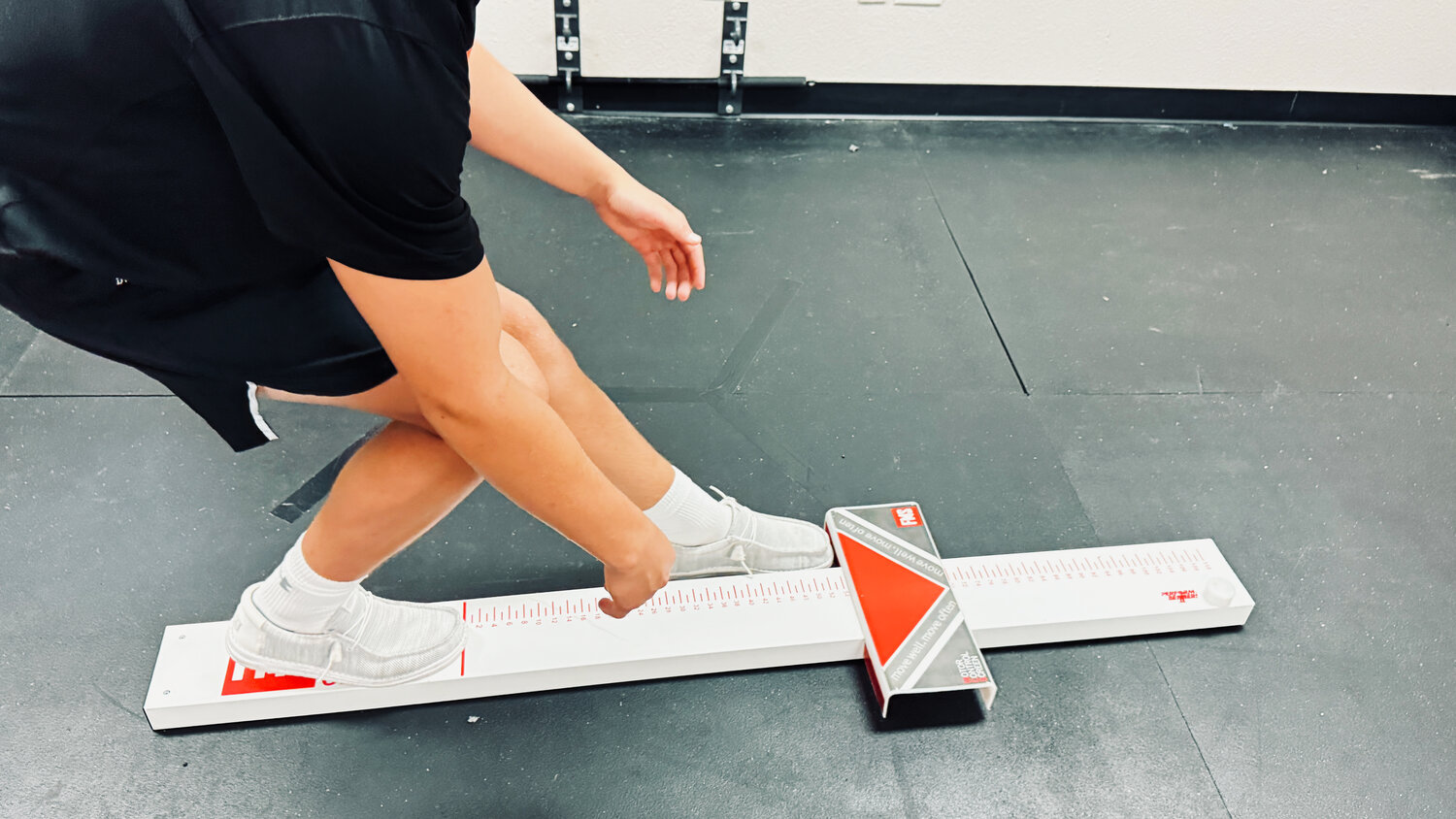
In the clinic we measure this precisely with the Functional Movement Systems Motor Control Screen — a reach test on a measuring beam that puts a hard number on each leg and exposes side-to-side differences. At home, you can get a useful first look with nothing but a timer:
- Stand on one leg, hands on your hips, other foot off the ground (don't let it touch or brace against your standing leg).
- Stand within arm's reach of a counter and hold for up to 30 seconds with your eyes open. Wobbling is fine. Stop the timer if your foot touches down, you hop, a hand leaves your hip, or you grab the counter. Take two tries per leg and keep the better one.
- If 30 seconds was easy on both legs, try it with your eyes closed, still next to the counter, for up to 10 seconds. Skip this part if you've had a fall in the past year.
- Test both legs — and pay attention to the difference between them.
What you're looking for is the difference between your legs. If your lead leg is noticeably shakier than your trail leg (or the other way around), you've found a difference worth looking at. It doesn't tell you why, and it isn't a diagnosis of your swing, but it can help explain why swing cues alone haven't stuck. Your pro can't coach your body into a position it can't control.
How we fix it
Hands-on treatment — adjustments and soft-tissue work — gets the hips moving and calms down what's tight, and that's the fast part. But it's the start, not the finish. Lasting change comes from retraining the control and strength that let the fault build up in the first place. That's the corrective work you do between visits, and it follows a simple progression: free up the hips, wake up the stabilizers, then load the pattern until your body trusts it.
The drills, in order
- 90/90 hip switches (mobilize) — Sit on the floor with one leg bent 90 degrees in front of you and the other bent 90 degrees behind. Sit tall and rotate your knees side to side, switching the front and back leg without using your hands. Slow and controlled, 8–10 switches. Balance lives in the hips — you can't stabilize a joint that can't move.
- Single-leg glute bridge (activate) — Lie on your back, knees bent. Lift one foot off the floor and drive through the other heel to bridge your hips up. Keep your pelvis level — if one side sags, that's the weakness talking. 2 sets of 10 per side. This wakes up the glute that's supposed to be steering each hip.
- Lateral band walks (load it — side-to-side control) — Loop a light band around your legs just above the knees, sit into a quarter squat, and take slow sideways steps, keeping tension on the band and your knees tracking over your toes. 10 steps each direction, 2 rounds. This trains the hip to resist the sideways drift that can become a sway or slide.
- Single-leg Romanian deadlift (load it — full pattern) — Stand on one leg with a slight knee bend, hinge at the hip and reach your hands toward the floor while the free leg extends behind you, then return to standing without touching down. Bodyweight first; add a dumbbell when it's smooth. 8 per side. This is single-leg balance under load — the closest gym move to what your swing demands.
- Step-change drill (groove it into the swing) — Start with your feet together, club out in front of you. Swing the club back, and as it passes your feet, step toward the target with your lead foot, then finish the swing. The club is still going back while your weight is already moving forward — that's you learning to shift into the lead leg and trust it, slow and deliberate. This is a feel drill, not a power drill. 10 easy swings.
Spend 10 minutes on these most days and retest your single-leg balance in three or four weeks. Compare your numbers with your own first try. If the shakier side catches up, ask your pro whether they see a change in your swing.
When to get it looked at
If your balance test shows a clear side-to-side difference, if the drills feel impossible on one leg, or if you've been grinding on the same fault for months with no progress, it's time to find out which piece is contributing. Mobility, stability and motor control are each trained differently, and guessing wastes your season. Fort Worth golf is a year-round game; you don't have an offseason to burn.
Want to know which piece it is for you? Book a golf evaluation at Taylor Made Integrative Therapy. We'll test what your body can and can't do, including a real number on each leg with the Motor Control Screen, and build a plan around it. Call or text (817) 523-9590. Move better, feel better, and play your best golf.
Book Your Golf Evaluation →Prefer to talk first? Call or text (817) 523-9590 or email info [at] tmitherapy.com.

Dr. Taylor is a TPI-certified sports chiropractor at Taylor Made Integrative Therapy in Fort Worth, TX. He helps golfers, athletes, and active adults move better, feel better, and perform at their best — by fixing the movement issues underneath the pain. More about Dr. Taylor →