
One muscle, or a chain of them?
A standard stretch picks one muscle and pulls on it. That's useful when one muscle is the limit. But when you rotate, your hip, pelvis, ribs, and shoulders all have to move in a coordinated sequence.
One popular way to picture this is the Spiral Line, from Thomas Myers' Anatomy Trains. It describes a path of connected tissue that wraps from the head across the ribs to the opposite hip and down the leg, like the stripe on a barber pole. It's a model, not a wiring diagram, and researchers still debate how literally those lines work as separate structures. I use it as a way to think about the position, not as proof of what the drill does. And I'm not claiming the Brettzel stretches the whole line.
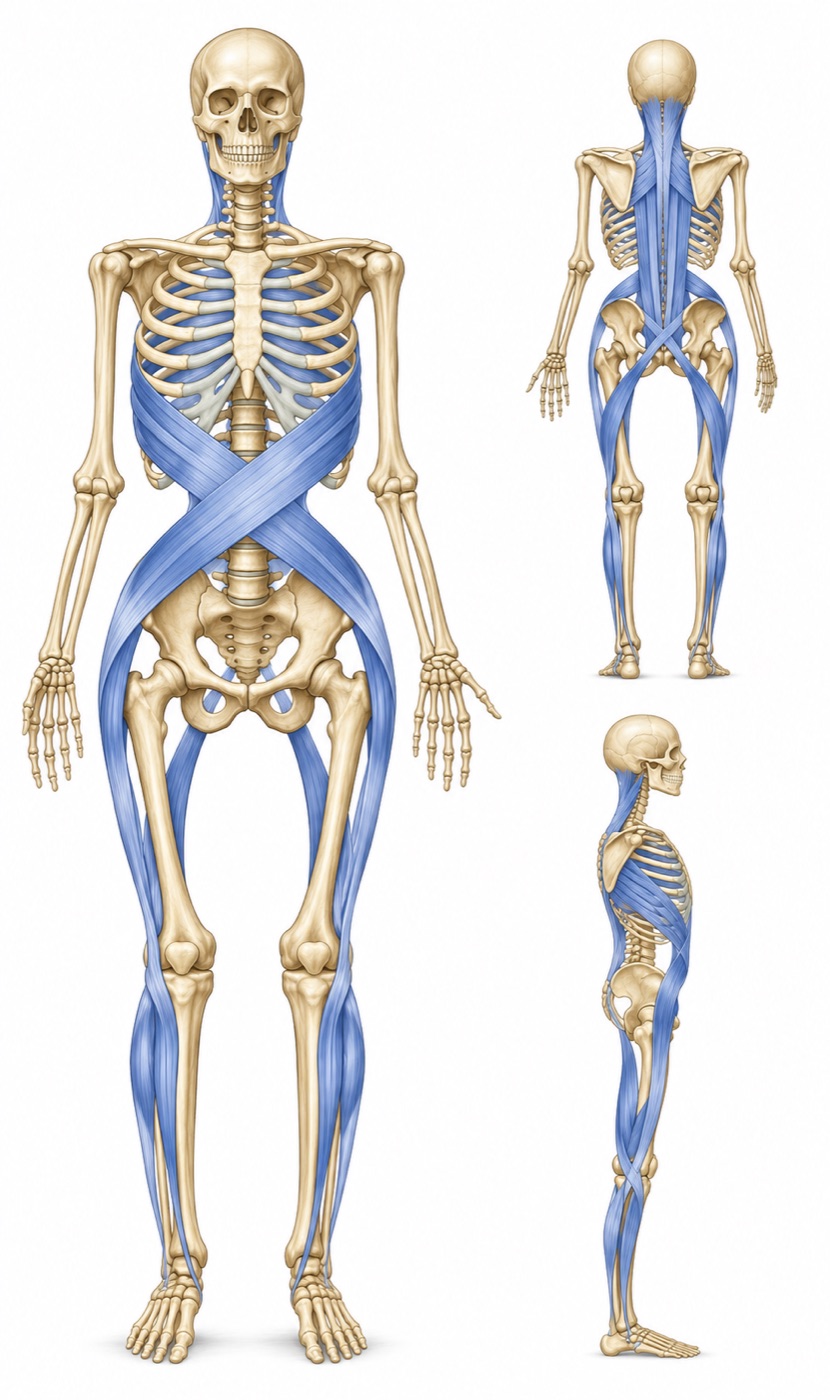
What I see in the office is simpler: when someone tells me where they feel a stretch, I also watch how their hips and upper back move when they turn. The limit isn't always where the stretch is felt.
Why this matters for turning and swinging
Golfers hear "turn more" all the time. In a backswing, your chest and your pelvis both turn away from the target, with the chest turning farther. When a golfer tells me the backswing feels stiff, I watch for things like extra arching through the low back or reaching farther with the lead arm.
A single-muscle stretch doesn't ask your hip and your ribs to do anything together. The Brettzel asks you to feel both at once, slowly, on the floor. It's a way to practice that relationship, not a copy of the swing.
The Brettzel Stretch
Here's the full walkthrough.
- Lie on your side with your head supported. Pull your top knee up past a right angle at the hip and hold it there with your bottom hand.
- Bend your bottom knee and keep that thigh roughly in line with your body. Reach back with your top hand to hold that ankle. If you can't reach it comfortably, loop a towel or strap around the ankle.
- Relax, then rotate. Take an easy breath in. As you breathe out, open your chest toward the ceiling, away from your top knee, and let your top shoulder drop toward the floor behind you. Stop where it still feels comfortable.
- Repeat until you reach the end of your comfortable range.
- Optional: keep both legs where they are. Gently try to bend the bottom hip and straighten the top hip while your hands resist. Keep breathing for 5 seconds, then relax back into the stretch.
- Switch sides and repeat.
The cue to remember: breathe out as you turn, and stay in a range that feels comfortable.
What's happening in that position
You may feel a stretch at the front of the hip and thigh on your bottom leg. The top knee pulled toward your chest helps keep your pelvis and low back steadier, so more of the turn comes from your mid back and ribs. The slow exhale is a cue to ease into the turn.
Step five is a hold-and-relax variation, a common stretching technique. Some people find they can go a little farther afterward. If it doesn't feel good, skip it.
If you feel your low back arch as you reach for your ankle, use the strap and ease off the pull.
What to notice on each side
Pay attention to how the drill goes. Do you need the strap on one side? Does one side feel much tighter? Is rotating your shoulder toward the floor harder on one side only? That's something to notice, not a diagnosis. See whether the same side also feels stiffer during your swing or when you turn in daily life. If it does, that's worth mentioning at an evaluation. (Related reading: why stretching isn't fixing your tight hamstrings, and a 2-minute breathing reset if your ribcage feels stuck.)
When to stop and get it checked
Stay within the range you have. Stop if you feel pain, pinching at the front of the hip, numbness, or tingling anywhere. If you're recovering from hip, knee, or back surgery, check with your surgeon or rehab clinician before you try it. And if turning keeps hurting, or stiffness keeps getting in the way of your swing or your day, get it checked rather than adding another round of home stretching.
Can't turn the way you used to, or your swing runs out of rotation? At Taylor Made Integrative Therapy in Fort Worth, a movement and body-swing assessment looks at how your hips, ribs, and shoulders move together, and we talk through what to work on first. Depending on what we find, we may start treatment at your first visit.
Book Your Evaluation →Prefer to talk first? Call or text (817) 523-9590 or email info [at] tmitherapy.com.
Dr. Taylor is a TPI-certified sports chiropractor at Taylor Made Integrative Therapy in Fort Worth, TX. He helps golfers, athletes, and active adults move better, feel better, and perform at their best — by fixing the movement issues underneath the pain. More about Dr. Taylor →